Almost two years ago, Jackie Walker, Prairie District Neighborhood Alliance Vice President, asked me if I would volunteer and host a monthly movie event, in the South Loop that became known as “Meet Me at the Movies.” The concept: I would pick films to screen, introduce them, giving background and “color commentary” on each movie presented. Afterward we would go to a local restaurant to share a meal.
The first movie screened 17 months ago
My focus was on classic Hollywood films. The reasoning? Films made before the end of the production code—the mid-1960s—were for the most part, appropriate for all audiences and tended to fit within a two-hour time frame. In addition, it gave me great pleasure introducing these classic films to people who were unfamiliar with them.
Hollywood’s golden age was a period of great creativity and artistry. So much of our popular culture comes from the movies. “Here’s looking at you, kid,” uttered Humphrey Bogart to Ingrid Bergman in Casablanca. “How does a girl like you get to be a girl like you?” Cary Grant questioned Eva Marie Saint in North by Northwest, the very first MMATM event. But my all-time favorite line is, “For a charming, intelligent girl, you’ve certainly surrounded yourself with a remarkable collection of dopes,” spoken by Dana Andrews to Gene Tierney toward the end of Laura.
"Casablanca" really packed the house.
It was tough deciding on which classic films to screen, but I enjoyed the challenged. We screened some of the best movies Hollywood produced and showcased some of the silver screen’s most popular stars at the height of their careers, including Cary Grant, Grace Kelly, Humphrey Bogart, Ingrid Bergman, Dana Andrews, Jeanne Crain, Joseph Cotton, Teresa Wright, James Stewart, and Sophia Loren to name a few. And who could forget Marilyn Monroe, Tony Curtis, and Jack Lemmon in Some Like it Hot?
Marilyn Monroe and her "bosom" companions in "Some Like it Hot"
One of the best things about MMATM was meeting and getting to know my neighbors in the South Loop. Over the months, we developed into a community of classic movie fans, who just happened to live in the same Chicago town. What was even more gratifying were the regular attendees who came from the north and south sides of the city. I was honored that they made the trip and worked hard not to disappoint them for making the journey.
James Steward and Grace Kelly solved a murder in the Hitchcock classic, "Rear Window."
Picking movies and preparing monthly presentations may not seem like much, but it was a big time investment. For this and other reasons I decided not to move forward with MMATM. I submitted my resignation to Tina Feldstein, PDNA president, and Walker before the screening of the season’s last film, The Bishop’s Wife. According to their Web site, they’re planning to continue with MMATM starting in January. Not sure what the “new” MMATM will look like, but you might want to give it a try.
Howard Keel and Betty Hutton in "Annie Get Your Gun," the first musical screened by MMATM
Thank you to all the people who came out month after month, the ones I knew by name, and the new folk that seemed to come almost every month. It was a wonderful 17 months. I will always remember my MMATM experience with great fondness. For a look back from a regular MMATM attendee, check out Bonnie McGrath's blog at the Chicago Journal by clicking here.
The Prairie District Neighborhood Alliance (PDNA) invites you to "Meet Me at the Movies," Friday September 24, 2010 at 6:30 p.m. at Sherwood Community Music School, Columbia College recital hall, 1312 S. Michigan Ave. The wrap party (dinner after movie) will be held at the Weather Mark Tavern 1503 S. Michigan Ave.
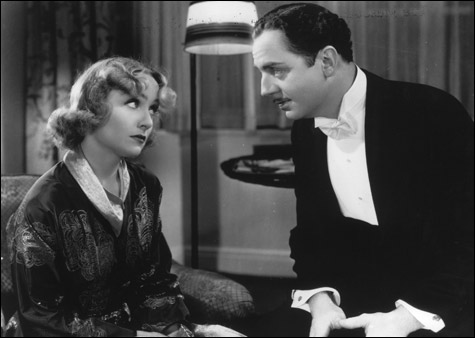
Classic performances and situations have made My Man Godfrey one of the best film comedies ever made. My Man Godfrey was the first film to receive Academy Award nominations in all four major categories, including Best Actor and Best Actress for William Powell and Carole Lombard respectively. Film critic Roger Ebert in a review of the movie simply said, “God, but this film is beautiful” and it truly is. My Man Godfrey is ranked 44 in the American Film Institute’s (AFI) “America’s 100 Funniest Movies” compiled in 2002. Not bad for a movie first released in 1936.
Lombard was so identified with the screwball comedy genre that Life magazine dubbed her “the screwball girl” in a 1938 cover story. When paired with Powell, no stranger to comedy himself, MyMan Godfrey becomes a master class of screwball comedy technique.
Carole Lombard and William Powell in My Man Godfrey
Admission to the movie is $5. Dinner afterward (not required) is $15 per person. To RSVP to this event and/or the wrap party click here.
Before anyone heard of a place called Hollywood, Chicago played an important role in the history of film in America.
Charlie Chaplin and Gloria Swanson Slept (and worked) Here
Before the sound era, Chicago housed Midwest corporate offices for Paramount, Warner Bros., Universal, and the Samuel Goldwyn studios. Most of the offices were in Chicago's South Loop along Washash Ave. Other film offices were located one block east on Michigan Ave. During this period, major silent movie productions starring screen legends Charlie Chaplin and Gloria Swanson were made in Chicago.
Distribution Hub
Some evidence of this history still exists. The Film Exchange Lofts at 1307 S. Wabash Ave. was once owned by the Warner Bros. studio. They had corporate offices at that location, but its most important use was for storing film for distribution. With Chicago's location and access to train travel, it was the ideal distribution point for Chicago and Illinois theatres.
Ruins From Past Glories
The famous terra cotta archway entrance to the Jesse Lasky Famous-Players (a forerunner of Paramount) building on Wabash near 13th Street was rescued from destruction by Columbia College. It now stands in their Media Production Center at 1600 S. State St.
The Prairie District Neighborhood Alliance (PDNA) invites you to "Meet Me at the Movies," Friday February 26, 2009 at 6:30 p.m. at Sherwood Community Music School, Columbia College recital hall, 1312 S. Michigan Ave.
There never was a woman like Gilda! That was the tagline for Gilda, the 1946 film classic starring Rita Hayworth and Glenn Ford. Hayworth caused a sensation as the conflicted title-named heroine. When she sang "Put the Blame on Mame," in a skintight Jean Louis gown, Hayworth secured her place in film history.
The story begins with Johnny Farrell (Ford), a down-on-his-luck small-time gambler who ends up in Buenos Aires, Argentina. After cheating two men at craps, a mysterious man (George Macready) saves him from being robbed. The mysterious man tells Johnny about an illegal casino and warns him not to use his cheating skills there.
Right-hand man Intrigued, Johnny finds the high-class gambling joint and begins cheating the house. Before he knows what's happening, Johnny is surrounded by the casino's watchful staff and taken to the owner, Ballin Mundson, the mysterious man, who saved him from thieves! Johnny convinces Mundson that he should hire him. Mundson does just that and before you know it, Johnny is his right-hand man.
"I hate you, Johnny!" When Mundson returns from a trip with a beautiful, young wife (Gilda,) he asks Johnny to watch over her for him. What Mundson doesn't know is that Gilda was once Johnny's lover. The tension and hatred between Gilda and Johnny grows with each passing day. But is it really mutual hatred that stands between them?
Chemical reaction The on-screen chemistry between Hayworth and Ford set tongues wagging about a possible off-screen relationship. Both stars denied they were ever romantically involved, but remained life-long friends.
The "Love Goddess" is born After Betty Grable, Hayworth was the most popular pin-up girl during World War II. In a cover story in Life magazine, Hayworth was dubbed the "Love Goddess" a label that she personally hated, but one that followed Hayworth throughout her career.
Gilda was given the A-treatment by her home studio, Columbia Pictures. Charles Vidor (Cover Girl, Love Me or Leave Me) directed and cinematographer Rudolph Mate (The Pride of the Yankees, To Be or Not to Be) lovingly photographed Hayworth. As already mentioned, Jean Louis designed Hayworth's form-fitting costumes, which only served to reinforced her love goddess status.
Icon status Almost everything surrounding Gilda is iconic. Hayworth's look, her clothes, her "Put the Blame on Mame" performance, and even the movie poster itself is considered an iconic piece of promotional art. The Artist's Cafe in the Fine Arts Building, 412 S. Michigan Ave. has a foreign version of the Gilda poster hanging on its wall.
There were many memorable movies made and released during the late 1940s, but Gilda stands out among them and remains a classic today.
The Wrap Party for the January 29 "Meet Me at the Movies" will be at Kroll's South Loop. Kroll's is located at 1736 S. Michigan Ave.
Alfred Hitchcock's 1955 classic To Catch a Thief will be the featured movie that evening. The film will be screened at Sherwood Community Music School at Columbia College recital hall, 1312 S. Michigan Ave. The movie starting time is 6:30 p.m. The total price for the event will be $20 per person.
Academy Award Winner
Filled with all the things you've come to expect from Hitchcock--elegant surroundings, witty, sophisticated dialogue, and glamorous costumes--To Catch a Thief doesn't disappoint. Nominated for three Academy Awards (winning for Best Color Cinematography), this 1955 suspense classic is one fun ride.
For more information including how to RSVP, please visit The Prairie District Neighborhood Alliance (PDNA) Web site.

 . “How does a girl like you get to be a girl like you?” Cary Grant questioned Eva Marie Saint in North by Northwest
 , the very first MMATM event. But my all-time favorite line is, “For a charming, intelligent girl, you’ve certainly surrounded yourself with a remarkable collection of dopes,” spoken by Dana Andrews to Gene Tierney toward the end of Laura
 .
.
 ?
?

 . According to their Web site, they’re planning to continue with MMATM starting in January. Not sure what the “new” MMATM will look like, but you might want to give it a try.


 one of the best film comedies ever made. My Man Godfrey was the first film to receive Academy Award nominations in all four major categories, including Best Actor and Best Actress for
  and
and  respectively. Film critic Roger Ebert in a review of the movie simply said, “God, but this film is beautiful” and it truly is. My Man Godfrey is ranked 44 in the American Film Institute’s (AFI) “America’s 100 Funniest Movies” compiled in 2002. Not bad for a movie first released in 1936.


 , the 1946 film classic starring Rita Hayworth and Glenn Ford. Hayworth caused a sensation as the conflicted title-named heroine. When she sang "Put the Blame on Mame," in a skintight Jean Louis gown, Hayworth secured her place in film history.


 ,
,  ) directed and cinematographer Rudolph Mate (
 ,
,  ) lovingly photographed Hayworth. As already mentioned, Jean Louis designed Hayworth's form-fitting costumes, which only served to reinforced her love goddess status.