Tampilkan postingan dengan label Carole Lombard. Tampilkan semua postingan

Rabu, 20 April 2011

Fred MacMurray: Nice-Guy Movie Star

Fred MacMurray (1908-1991) was a popular movie star during Hollywood’s Golden Age. He was so popular, that in 1943, MacMurray was the highest paid movie star in the world. For most of his career, MacMurray played likeable characters in comedies, musicals, and dramas. The few times MacMurray played heavies or “bad” guys, he surprised audiences and impressed the critics. In the 1960s and 1970s, MacMurray was America’s favorite dad on TV’s My Three Sons.

Illinois Born
Born Frederick Martin MacMurray in Kankakee, Illinois. His parents, Frederick MacMurray and Maleta Martin, eventually settled in Beaver Dam, Wisconsin, where Martin was born.

Music Scholar and Broadway Star
MacMurray studied music in school and was talented enough to win a full scholarship to Carroll College in Waukesha, Wisconsin. In the early 1930s, he was part of an orchestra. He eventually ended up on Broadway working alongside the likes of Sydney Greenstreet and Bob Hope. In 1934, he signed with Paramount where he was groomed for movie stardom. In 1935, MacMurray appeared in seven movies, starring opposite some of the most popular leading actresses of the day, including Claudette Colbert and Katharine Hepburn. But it was his star turn opposite Carole Lombard in Michell Leisen’s Hands Across the Table that made him a bonafide movie star.

Box Office Success
Hands Across the Table was a breakthrough for both Lombard and MacMurray. The Lombard-MacMurray on-screen chemistry was a big hit with movie audiences. Paramount was quick to capitalize on their popularity by costarring them in three more films over the next two years. Lombard and MacMurray starred in two majors successes in 1937, Swing High, Swing Low (Paramount’s biggest success that year) and True Confession. Had it not been for Lombard’s untimely death in 1942, there might have been more pairings.

A "Paramount" Leading Man
During the late 1930s and 1940s, Paramount cast MacMurray opposite all of it’s top female stars, including Marlene Dietrich, Paulette Goddard, and Barbara Stanwyck. MacMurray starred with Stanwyck in the Preston Sturges scripted, Leisen directed classic, Remember the Night (1940), but it would be 1944’s Double Indemnity that would forever link the two together.

Icon Status
Cast against type as insurance salesman Walter Neff by director Billy Wilder, MacMurray showed a darker side the public had not seen before. Playing opposite Stanwyck as Phyllis Dietrichson and Edward G. Robinson as Barton Keyes, MacMurray, who was topped billed, more than held his own. The film was a hit with the public and most critics of the day. Over the years, the film’s reputation has grown. In 2007, the American Film Institute ranked Double Indemnity 29 on its list of the 100 best American Films, which was nine spots higher than when the poll was taken in 1998.

Fred MacMurray and Barbara Stanwyck in the Billy Wilder classic Double Indemnity
Popular Costars
MacMurray continued his winning streak throughout the 1940s. He developed a reputation around Paramount as the perfect leading man. Never overpowering the leading lady, MacMurray costarred in seven films with Colbert, four with Stanwyck as well as starring in several films with Goddard and Madeleine Carroll. MacMurray could carry a film on his own as evidenced by the successful Murder, He Says (1945), directed by George Marshall.

MacMurray and Claudette Colbert starred together in seven movies.

A Turn in the Road
In 1953, his wife of 17 years passed away, leaving him with two children: 13-year old Susan and seven-year-old Robert. The following year, he married June Haver; they adopted twin daughters Katherine and Laurie in 1956. During the mid-1950s, MacMurray, like James Stewart, stayed busy starring in mostly western movies. As the 1950s came to an end, MacMurray’s career took yet another turn.

MacMurray in The Absent-Minded Professor

Disney Legend
In 1959, Walt Disney tapped MacMurray for a starring role in The Shaggy Dog. The low-budget film was a monster hit for the studio, which led to the title role in The Absent-Minded Professor in 1961 and its sequel, Son of Flubber in 1963. Disney’s top director, Robert Stevenson (Jane Eyre, Marry Poppins), turned both films into box office gold.

MacMurray caused a stir by playing a philandering husband in The Apartment.

Wilder Called Again
Director Billy Wilder called on MacMurray once again to play against type in 1960’s The Apartment. Starring alongside Jack Lemmon and Shirley MacLaine, MacMurray played wife-cheating executive Jeff D. Sheldrake. His performance was jarring to many filmgoers, who were now used to his persona as a Disney star. The Apartment would be the last film in which he would play a heel.

The first season of My Three Sons featured William Frawley as Uncle Charlie.

 TV Star
Along with his new career at Disney, MacMurray entered series television in 1960 starring as widowed father Steve Douglas on My Three Sons. One of the most popular TV series of all time, it ran for 12 years and cemented MacMurray’s place in American popular culture. MacMurray, always the shrewd businessman, arranged his TV filming schedule so he could continue making films. Between 1959-1973, MacMurray starred in seven movies for Disney, with Charley and the Angel (1973) being his last.

Well Remembered
MacMurray's star is at 6421 Hollywood Blvd.
MacMurray had a natural, comfortable acting style that was often overlooked. His comedic timing was as good as anyone’s and his dramatic performances gain new respect and appreciation with each passing year. In 1987, MacMurray was the first person honored as a Disney Legend.


A true movie legend, MacMurray earned his star on the Hollywood Walk of Fame.


Trivia: MacMurray worked with two of his My Three Sons co-stars long before the series debuted. William Frawley, who played grandfather Bub, co-starred alongside MacMurray in The Princess Comes Across (1936). And William Demarest, who replaced the ailing Frawley as Uncle Charley, was one of Carole Lombard's prospective boyfriends in Hands Across the Table (1935).

Rabu, 24 November 2010

Fabulous headdresses


Anita Ekberg

Carole Lombard

Carmen Miranda - my friend has a brilliant framed photo of her kicking her leg up, she clearly didn't bother wearing knickers

Marlene Dietrich - I adore her clothes

Louise Brooks hiding her classic bob
Josephine Baker
Doutzen Kroes in Victoria's Secret

Lily Cole in Christian Lacroix

Seventies Cher
Photography by Mark SeligerThe gorgeous Gisele

Cher

Greta

Senin, 20 September 2010

My Man Godfrey this Friday

The Prairie District Neighborhood Alliance (PDNA) invites you to "Meet Me at the Movies," Friday September 24, 2010 at 6:30 p.m. at Sherwood Community Music School, Columbia College recital hall, 1312 S. Michigan Ave. The wrap party (dinner after movie) will be held at the Weather Mark Tavern 1503 S. Michigan Ave.

Classic performances and situations have made My Man Godfrey one of the best film comedies ever made. My Man Godfrey was the first film to receive Academy Award nominations in all four major categories, including Best Actor and Best Actress for William Powell and Carole Lombard respectively. Film critic Roger Ebert in a review of the movie simply said, “God, but this film is beautiful” and it truly is. My Man Godfrey is ranked 44 in the American Film Institute’s (AFI) “America’s 100 Funniest Movies” compiled in 2002. Not bad for a movie first released in 1936.

Lombard was so identified with the screwball comedy genre that Life magazine dubbed her “the screwball girl” in a 1938 cover story. When paired with Powell, no stranger to comedy himself, My Man Godfrey becomes a master class of screwball comedy technique.

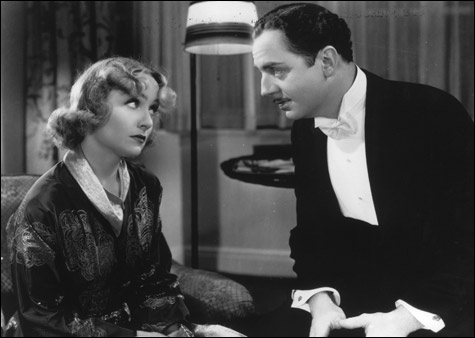
Carole Lombard and William Powell in My Man Godfrey

Admission to the movie is $5. Dinner afterward (not required) is $15 per person. To RSVP to this event and/or the wrap party click here.


Sabtu, 18 September 2010

Show you my wardrobe - Part two


I keep mentioning Hollywood glamour and staying in bed so I thought it only fitting that the next section of 'Show you my wardrobe' should be vintage nightgowns.  
These were all bought from estate sales in Hollywood or New York.  A couple were from Ebay in America.  I bought them from a lovely dealer I made friends with, a retired French horn player with the Metropolitan opera called Richard

Kamis, 26 Agustus 2010

Mitchell Leisen: The Best Director Nobody Knows

Mitchel Leisen's trademark signature
Sometimes history isn’t always fair. For example, there are movie directors and actors, who in their day, were enormously famous and successful, but for whatever reasons are almost forgotten today.

Paramount Director
Such is the case with Mitchell Leisen (1898-1972), a top director during Hollywood’s golden age. As a contract director at Paramount, he worked with all the top stars during that period: Carole Lombard, Claudette Colbert, Fred MacMurray, Jack Benny, Fredric March, Ray Milland, Marlene Dietrich, and Barbara Stanwyck.

Fred MacMurray
Early Commercial Success
Best known for his elegant romantic comedies, Leisen also excelled at action and melodramatic films. Leisen got his start as an art director and costume designer. Working under famed director Cecil B. DeMille, Leisen received his one and only Academy Award nomination for his art direction of Dynamite in 1930.  He eventually worked his way up the ladder, directing his first film, Cradle Song, in 1933. The next year, Leisen directed two popular films Death Takes a Holiday and Murder at the Vanities. In 1935, he knocked one out of the park with Hands Across the Table. This landmark romantic comedy made Carole Lombard a superstar and established Fred MacMurray as a top leading man. During the rest of the 1930s, Leisen made some of the most commercial films at Paramount, including Swing High, Swing Low which was the studio’s biggest moneymaker in 1937. That same year, he directed the classic Easy Living starring Jean Arthur. Leisen topped off the decade with the delightful Midnight starring Claudette Colbert and Don Ameche. This romantic comedy, one of the many great films released in 1939, unfortunately does not have the status of some of its less-worthy, but better-known contemporaries.

The Fabulous Forties
Claudette Colbert
During the next decade, Leisen produced more winners for Paramount. In 1940, he directed the classic Remember the Night starring Stanwyck and MacMurray. The sensitive Hold Back the Dawn (1941) provided Olivia de Haviland with one of her best film roles up to that time. Leisen’s masterful direction helped de Haviland receive her first Best Actress Academy Award nomination. Later in the decade, he would direct de Haviland in her Oscar-winning performance for To Each His Own (1946). In 1944, Leisen was trusted with directing two big-budget Technicolor productions: Lady in the Dark starring Ginger Rodgers and Frenchman’s Creek starring Joan Fontaine. Both films were huge commercial successes and both focused on the talent and beauty of the female leads. As Dona St. Columb, Joan Fontaine never looked more beautiful. In 1945 Leisen directed Paulette Goddard to one of her biggest commercial and critical successes in Kitty. After seeing Goddard in that film, French film director, Jean Renoir decided to cast her as the lead in Diary of a Chambermaid the following year.

Paramount's George Cukor
Leisen, like George Cukor, at MGM, had a reputation for his direction of women. A generation of leading ladies at Paramount owe Leisen a great debt. Many did their best work under his direction. For others, he crafted popular vehicles ideally tailored to their personalities.

TV Director
His success as a director continued into the early 1950s. Leisen’s last popular success was The Mating Season (1952) starring Gene Tierney, John Lund, and the Oscar-nominated Thelma Ritter. After The Girl Most Likely in 1958, with movie projects nonexistent, Leisen turned his attention to television, directing episodes of popular shows like the Twilight Zone, Wagon Train, and The Girl from U.N.C.L.E.

Of all the directors to come out of the studio system, Mitchell Leisen was one of the best. And one day, I hope, he’ll receive the recognition and honor he deserves.

Selasa, 10 Agustus 2010

I love headdresses


Alice Dellal in Pam Hogg


Sophie Willing in Pam Hogg


Headdress by Rebecca Raa


Stephen Jones for Christian Dior


Marlene Dietrich


Carole Lombard


Carole Lombard


Hedy Lamarr
I love all these headdresses.  I can't walk past a fabulous hat or headdress without trying it on.  I would wear any of these. 
I once went to a party dressed a  showgirl.  I loved my outfit particularly the

Jumat, 11 Juni 2010

Been There Dunne That

Today, Irene Dunne is remembered as one of the top movie actresses from Hollywood’s golden age. She was nominated for five Best Actress Oscars between 1931 and 1949. Although she never won a competitive Oscar, she excelled at both comedy and melodrama. Dunne was known for her professionalism on and off the set. As far as her personal life was concerned, Dunne was never the subject of negative press. And she was married to the same man for 37 years, practically a miracle in Hollywood.

Kentucky-Born, Indiana-Bred
Dunne was born in Kentucky in 1898, but moved to Madison, Indiana, after her father’s death when she was 12. Dunne’s mother encouraged her young daughter to study piano and voice. As an adult, Dunne won a scholarship to Chicago Musical College, now part of Roosevelt University. After she earned her degree, Dunne was determined to sing Opera at New York’s Metropolitan. While performing as Magnolia in the Chicago company of Show Boat, Dunne was discovered and signed to a movie contract with RKO. The studio wanted to groom her to star in movie musicals. The Metropolitan Opera would have to wait.

Slow Start
In the early days of talking pictures, musicals were all the rage. Dunne’s first film was the forgotten musical comedy Leathernecking (1930). Unfortunately for Dunne and RKO, the popularity of movie musicals was in decline and Leathernecking was a flop. The following year would prove to be a game-changer.

An Epic Performance
Dunne’s next role was as Sabra Cravat, the heroine of Edna Ferber’s epic novel Cimarron (1931). Still relatively unknown, it was remarkable that she was given such an important part. The film, costarring Richard Dix, was an immediate critical and financial success. It brought Dunne her first Best Actress Academy Award nomination and it set the course of her career for the next five years.

Queen of the Weepies
Instead of starring in musicals, the career path RKO originally plotted for her, Dunne was cast in a series of successful melodramas. These melodramas included Back Street (1932), This Man is Mine (1934), and Magnificent Obsession (1936). Due to her commercial successes in melodramas, she was dubbed the "Queen of the Weepies," in the trade. Dunne did make two musicals during this period: Roberta (1935) and Show Boat (1936). Both movies were hits, but they didn’t have the world clamoring for more Irene Dunne musicals.

The Reluctant Comedianne
Producers saw something in Dunne’s portrayal of Magnolia, another Edna Ferber character, in Show Boat. It was the ability to let herself go in the musical numbers. There was joy and humor in her performances. The studio suits theorized that Dunne would be perfect for the role of Theodora Lynn in Theodora Goes Wild (1936) on loan-out to Columbia. But Dunne didn’t like comedy. Plus she had an excellent career as a dramatic actress and didn’t want to damage her reputation by giving a poor performance. So adverse was Dunne to playing Theodora that she took an extended vacation in Europe, hoping the studio would assign the role to another actress. After much prodding and pleading, and a few threats from Columbia, Dunne finally relented. What happened would be a major high point in an already successful career.

This Place is Full of Aunts
In Theodora Goes Wild, Dunne plays a small-town girl raised by two maiden aunts. Unbeknownst to them and the rest of the inhabitants of Lynnfield, CT, is the secret that Theodora has written a monster best-selling novel, The Sinner, under the penname, Caroline Adams. On a visit to her publisher in New York City, Theodora meets an unhappily married artist who seems to think Theodora needs to loosen up and live a little. As the movie progresses, Theodora does loosen up, but realizes she’s not the only one whose life could use a shot of excitement. Dunne’s character eventually reveals her true identity and throws caution to the wind, while the rest of Lynnfield is left dumbstruck.

Wild Success
Theodora Goes Wild was an instant hit with film critics and audiences. For her tour de force performance, Dunne received her second Academy Award nomination for Best Actress. As the choir-singing, organ-playing, church soloist, all of Dunne’s talents were on display.

Good Company
Dunne and Theodora were in good company in 1936. Frank Capra’s Mr. Deeds Goes to Town and Gregory La Cava’s My Man Godfrey were also released that year. Dunne’s fellow Hoosier, Carole Lombard, was nominated for Best Actress. Both Dunne and Lombard lost out to Louise Rainer, who had a supporting role, if that, in The Great Ziegfeld, in one of the most controversial Best Actress races of all time.

Comedy Classics
Looking back, it’s hard to understand Dunne’s reluctance to play Theodora. She performs the role so effortlessly and is so believable. It’s a good thing too because if we don’t believe Dunne and her genuine small-town goodness, the movie doesn’t work. Perhaps Dunne realized this when she saw the script and knew if not played just right, it would be an utter failure, a failure laid entirely at her feet. Fortunately for Dunne and film history, she was more than up to the task. If there was no Theodora, chances are there would be no Lucy Warriner in The Awful Truth, no Ellen Arden in My Favorite Wife, and no Nancy Andrews in Unfinished Business. And that would have been a pity. A real pity indeed!
Sources used: Irene Dunne: First Lady of Hollywood, Wes D. Gehring, Scarecrow Press, Inc., Lanham, MD, copyright 2003
Romantic Comedy in Hollywood: From Lubitsch to Sturges, James Harvey, Da Capo Press, New York, NY, copyright 1987